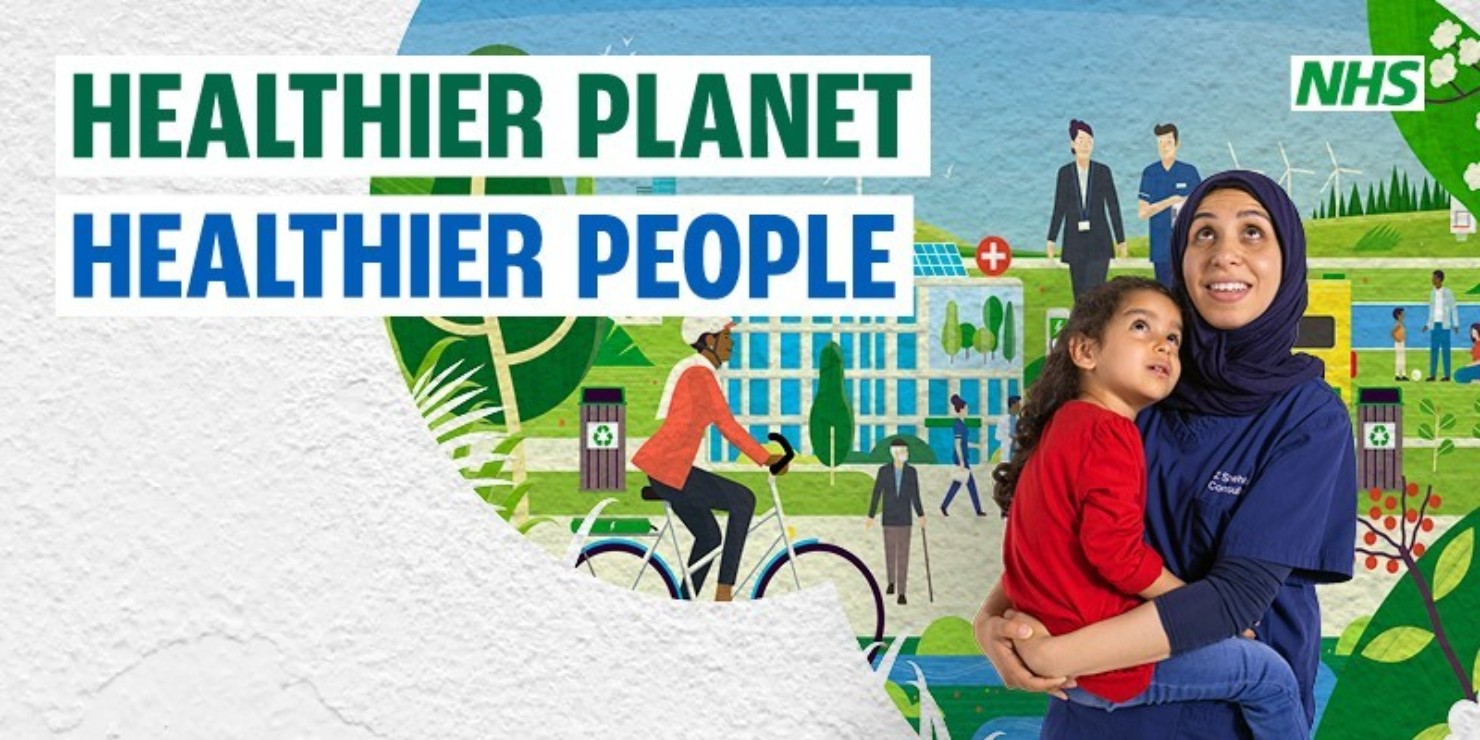
We’re improving healthcare with a Greener NHS.
Our Green Plan Vision
By working with our system partners, we will deliver Greener NHS’s national vision of a Net Zero health service by delivering change where we have direct control, and influencing what we can indirectly control, so that we are responding to climate change, improving health and creating healthier places, people and futures in the Black Country.
Our Black Country Green Plan
This year, we are proud to launch our refreshed Black Country ICS Green Plan for 2025-2028 which sets out how we will reduce our carbon footprint, improve air quality, and decarbonise care. This is part of our commitment to the national Greener NHS journey.
Why does this matter? The NHS is responsible for around 4% of the UK’s carbon footprint. Here in the West Midlands, we’re already seeing the effects of a changing climate, from more frequent heatwaves to poor air quality. By acting now, we can protect the health of our patients, our communities, and future generations.
Our Green Plan Refresh is grounded in a bold vision: To deliver outstanding healthcare while protecting and enhancing the environment for future generations. This vision is operationalised through the following strategic objectives:
- Achieve net zero for the NHS’s direct emissions (the NHS Carbon Footprint) by 2040, with an ambition to achieve an 80% reduction by 2028–2032.
- Achieve net zero for the NHS Carbon Footprint Plus (including supply chain and wider indirect emissions) by 2045, with an ambition to reach an 80% reduction by 2036–2039.
- Improve health outcomes by reducing air pollution and supporting adaptation to the health impacts of climate change.
- Embed sustainability in all aspects of NHS leadership, decision-making, and clinical practice.
Over the last three years, the Black Country has secured £66,334,000 of funding to cut energy demand and generate renewable power. It is estimated that his will deliver a total of 2,997 tonnes of carbon while also reducing energy costs. As we look to the future, this investment will help us build a greener, more resilient health service.
Anaesthetic gases are a significant source of emissions. Trusts are reducing their use of nitrous oxide by changing clinical practice and improving patient care. Many are now removing outdated pipe networks to minimise leaks and waste, instead switching to portable cylinders that connect directly to anaesthetic machines. In July 2025, with support from Mitie, Dudley successfully decommissioned the Nitrous Oxide Manifold at Russells Hall Hospital. This single action is expected to save an estimated 414 tonnes of carbon every year.
Sustainable travel is another key focus. We’re helping patients and staff make greener choices by offering a range of free bus travel schemes with the support of local operators and Transport for West Midlands. Between July and March 2025, 1,600 staff members have benefitted, making over 52,500 journeys and saving around 21 tonnes of carbon.
Together, these steps are helping us build momentum towards our net zero ambitions.
Our staff give us great ideas
Everyone can do their bit. No matter how small. The more of us who introduce small actions into our everyday routines, the more we can lessen our impact on the environment, and the more we can improve health. That’s how our staff are helping us to change for the better.
NHS staff with an interest in sustainability are invited to join the Greener NHS Knowledge Hub on FutureNHS. This workspace connects you to information, tools and resources, and provides a space for you to share your knowledge, ideas and best practice. You can also see a wide range of case studies and join our discussion forum.